
MR.ANDERSON.ROCKSA Tar Is Born
A Tar Is Born
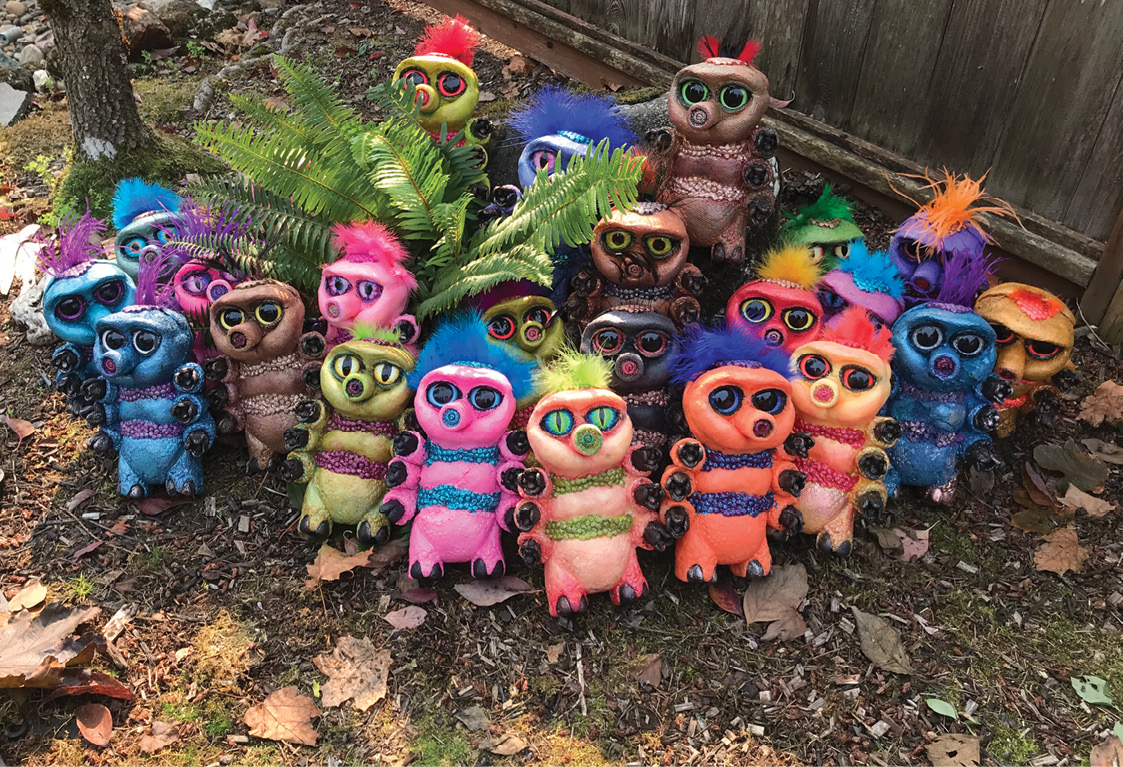
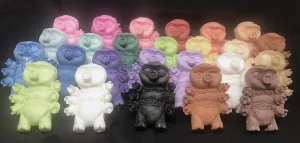
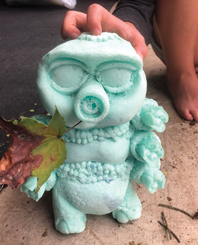
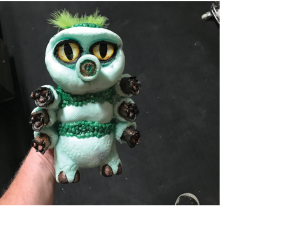
Meet Truman, first born among tardigrade babies and affectionately named by my granddaughter Lydia. He’s one of more than two dozen in this first batch of 8-inch foam figures sculpted in clay and cast in a silicone mold.
When I observe my granddaughter and other children playing with the color brood, I have a feeling these cuties will become the runaway stars of Tardigrades In Space!
Sure, they’ll get into mischief, but sometimes they’ll also save the day as adult “Tardigrups” pilot them through teachable microverse adventures aboard the I.S.S. Eukaryote.
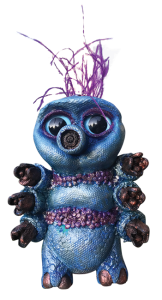
Each “Tardibabe” is uniquely cast in a single batch of tinted polyurethane foam and decorated with iridescent paints, puppy-dog eyes and wispy feathers. Every casting has random imperfections, and it seemed right to leave their “scars” and “birth marks” in homage to every living creature’s unique and individual representation on Earth.
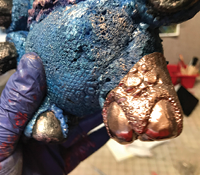
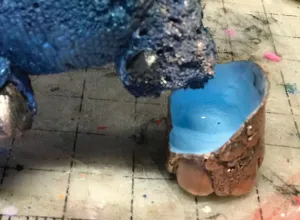
In keeping with the show’s special sensitivity to “the least of these,” one little guy came out so rough that I made him a prosthetic foot as a talking point for promoting empathy and compassion in young viewers.
Gallery
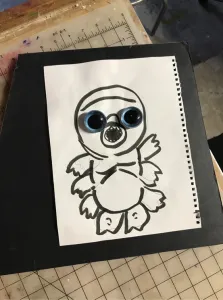
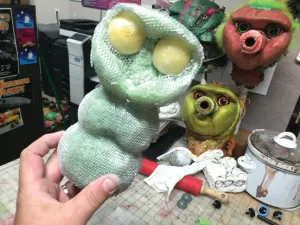
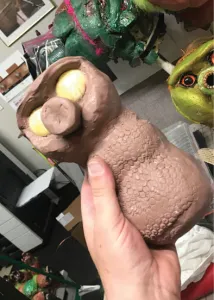
I started with a simple sketch to scale with the large puppy-dog eyes I purchased online. The eyes are transparent, so I place a colored disc of paper or craft foam behind each eye to color the iris.
The basic body shape was carved from a block of green florist’s foam and covered with pliable aluminum screening. Like stucco, modeling clay requires a textured substrate for proper adhesion to the base form.
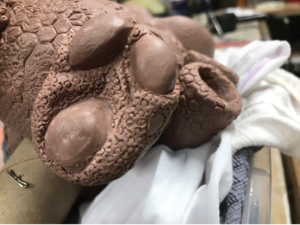
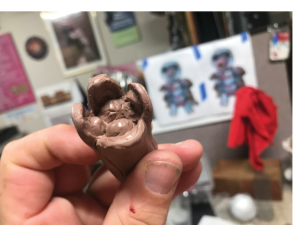
I went through several attempts sculpting the baby’s snout. The FlexFoam-iT! III by Smooth-On is self-skinning and can capture intricate details from the silicone mold walls, so I put a lot of tiny textures into the clay sculpture.
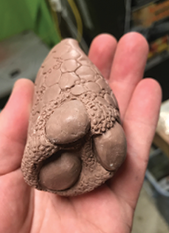
For scale, here I am holding one of the bottom feet before adhering it to the body by slightly melting both surfaces with a heat gun; the wax-based clay bonds and cools in a few seconds.
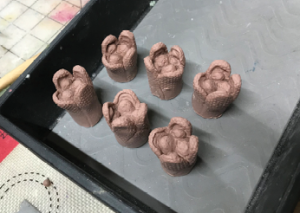
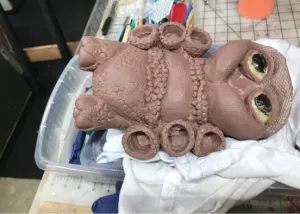
After sculpting an individual hand, I poured a silicone mold and cast additional hands using liquid Monster Clay melted in the microwave. It was a great discovery, as liquid Monster Clay begins solidifying almost immediately, especially if the silicone mold has been chilled before pouring.
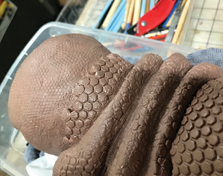
Here are detailed images of skin textures, front and back. Each puppet baby would be cast as a single foam rubber piece.
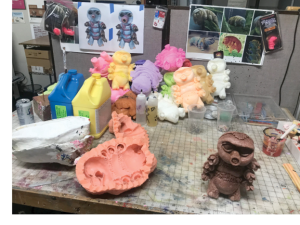
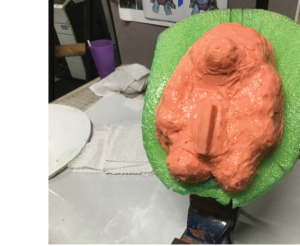
When I first placed one photo below, I assumed it was the finished clay sculpture standing next to its silicone mold. Then I realized it was actually a foam-rubber casting I had tinted chocolate brown. It captured mold details so well I thought it was the original clay sculpture.
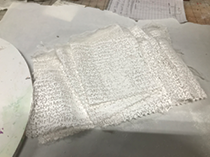
After coating the master clay sculpture with a thick layer of silicone, I built up a two-part plaster shell with the same infused gauze used by doctors to set a cast on a broken arm or leg.
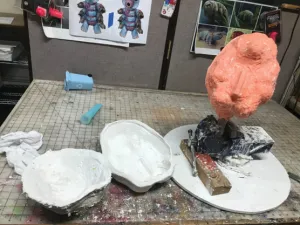
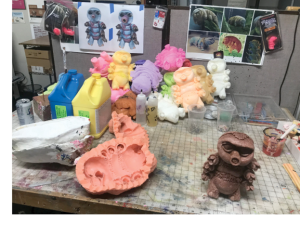
Here is a wider view of the chocolate foam puppet standing next to the silicone mold and plaster mother shell. Behind are the gallon jugs of Smooth-On FlexFoam-iT! III, which are mixed at a one-to-one ratio and tinted with batch-by-batch colorant pigments.
Here are the foam-rubber castings made from the initial silicone mold. One rough blue baby experienced deformation as the mold failed, but he became a potential role model for children with physical challenges and a source of empathy for typically-abled children.
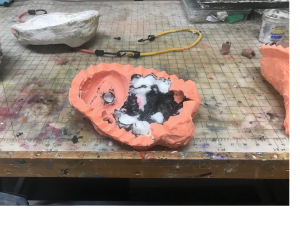
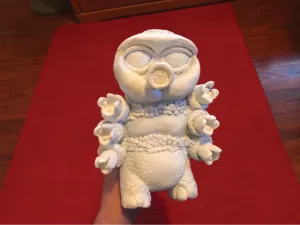
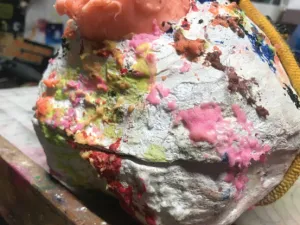
After two dozen foam castings, the silicone mold failed, meaning the expanding foam stuck to the mold walls. Fortunately, I had just enough two-part silicone in stock to make a replacement front half using the original Monster Clay sculpture.
To avoid this mold-failure dilemma from the start, one of the first castings should be made with rigid resin to create a library cast that can be stored for making future silicone molds.
Because the resin becomes extremely hot during the chemical curing process, I used a slip-cast or roto-cast approach, pouring several small batches of liquid resin into the hollow silicone mold and swishing each layer until it cured into a tough outer shell.
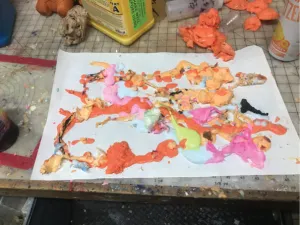
TARDI-CHOW: each tinted-foam casting produced small amounts of overflow. I pour these onto waxed paper to build up micro-biomes, abstract wall art interpreted as the organelles, microtubules, vesicles and DNA contained in the cytoplasm of plant cells.
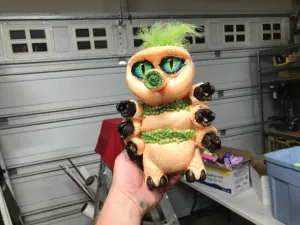
A TAR IS BORN: each TardiBaby starts as a tinted foam rubber character. Layers of flexible fabric paints add luster and luminescence to the base skin color. Glass eyes replace molded foam sockets, acrylic paints adorn hands and body segments, and brightly dyed feathers complete the hairline.
BLUE BABY: this term is apropos for the deformed final casting mentioned above. Here is a picture of his rough foot beside a bronze prosthesis I made from the same silicone puppet mold.

I’ve been calling them puppets, but they’re more like cuddly stuffed animals. However, they will still be used in video production with limited body movements and carefully framed close-ups.
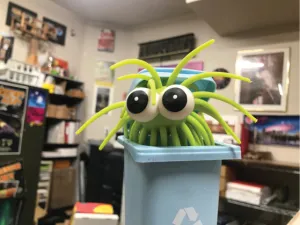
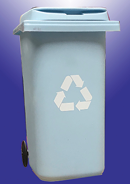
INSPIRED BY SESAME STREET: from items purchased at a Dollar Store, I puppetized a blue plastic recycling bin with a pop-up friendly virus named Pico.
Hmmm—it didn’t occur to me until writing the above entry: a recycling bin is an apt home for a virus. Viruses reproduce by pulling the chemical building blocks from the host cells they infect, recycling or perhaps up-cycling materials.