
Bacteriophages
Bacteriophages
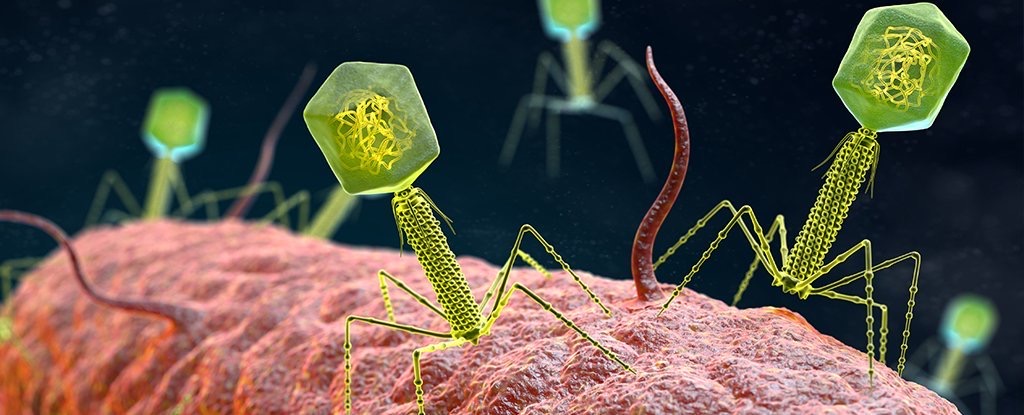
This blog entry journals the sculpting and molding of two different sizes of BACTERIOPHAGE models that will be used in the “Tardigrades in Space” video series.
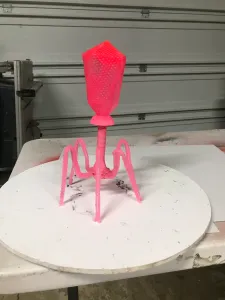
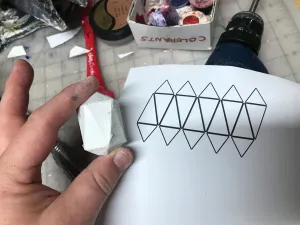
Phages are extremely geometric. In fact, on certain phage species the capsule at the top, which contains the phage’s DNA, is a mathematical shape called an icosahedron. This is a polygon with 20 faces. I found a template online and modified it in Adobe Illustrator into several different varieties.
For the large model I created an icosahedron with elongated center triangles. For the miniature models I sculpted two: one similar to the large model, the other symmetrical, almost like dice you would use for a game of “Dungeons and Dragons.”
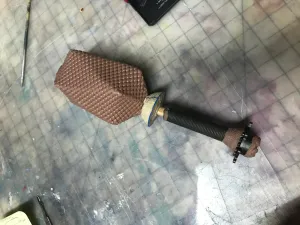
Starting with the large model, I wanted the surface of the capsule to resemble a geometric molecular pattern. After some searching at Home Depot, I purchased a sheet of textured plastic used as inserts for fluorescent ceiling lights.
I experimented with pouring melted Monster Clay over the sheet, then cutting and folding it into the icosahedron over a cardboard form. This proved difficult to shape cleanly, so I tried plastic resin, which remains semi-flexible until fully cured.
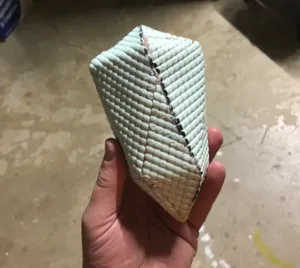
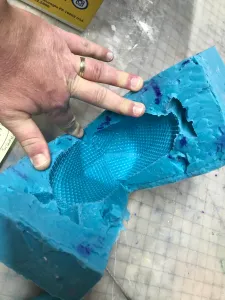
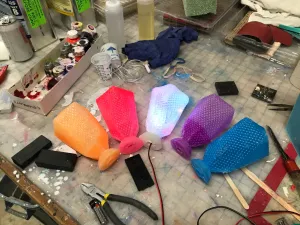
I ended up using this resin version for the silicone capsule mold. The capsules needed to be hollow to conserve material and allow for interior lighting, so I rotocast by pouring pigmented semi-clear resin into the silicone mold and rotating it by hand until it set.
After curing, I drilled a hole in the base as a point of entry for a light bulb as well as the vertical neck, or “sheath,” which would be cast as a solid piece in a separate silicone mold.
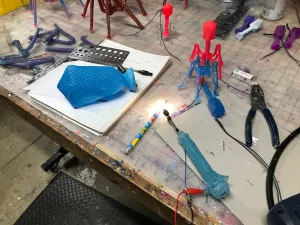
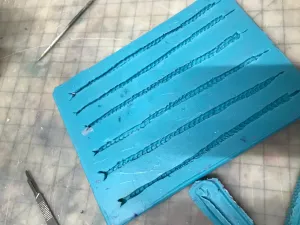
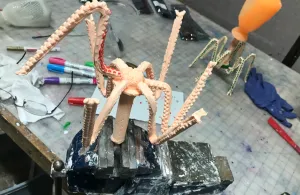
The legs were cast in a third mold as flat units. Prior to pouring I inserted thick wire into the mold. While the resin was still warm and semi-flexible, I bent each of the six legs to the proper shape with pliers; the embedded wire kept the shape while the resin hardened and allowed further adjustment for leveling on various surfaces.
To represent the strand of DNA contained in a phage’s capsule, I decided to use lights, besides it adding an awesome visual effect.
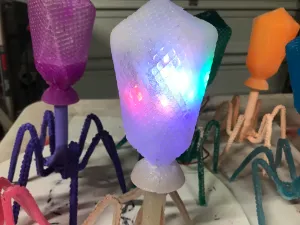
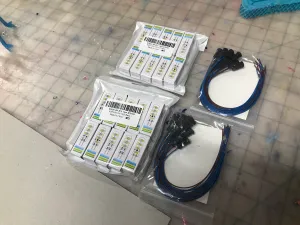
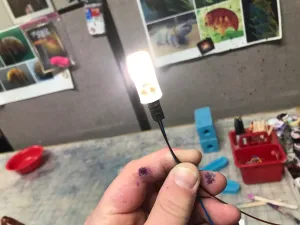
For my first attempt at interior lighting I used 12 volt LEDs, but they weren’t bright enough individually to accomplish the look I was seeking. I ordered under-cabinet LEDs and wire sockets online.
Each bulb is a tiny array of individual diodes facing outward. They are meant to replace white-hot halogen bulbs, run off only 12 volts, and generate almost no heat. When put into the hollow resin capsule of a large phage model they produce a wonderful internal glow.
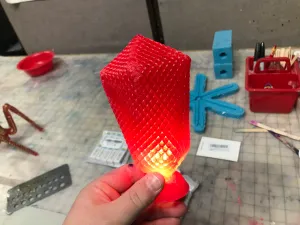
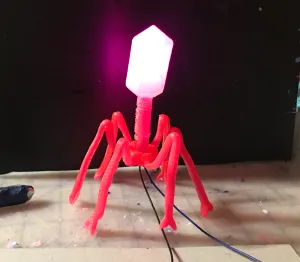
They would make great bedside night lights for children who like science. After making about a dozen large models, I decided to sculpt tiny ones. They’re about the same size as the Tardigrade figurines and will fit inside the same plastic clamshells I plan on using to sell figurines on MrAnderson.Rocks, along with other merchandise to help fund video production projects.
PHAGE FIGURINES
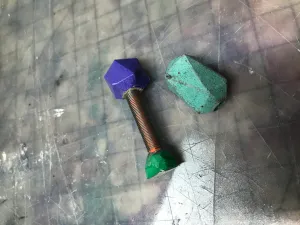
Though these miniatures are cast in solid resin, interior lighting is accomplished by inserting a single LED into a drilled hole. I made these smaller versions so that I could use them in filming scenes where dozens of phages are attacking a bacterial surface.
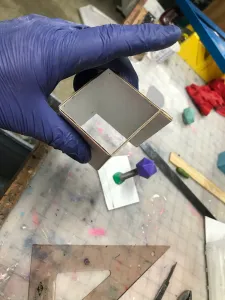
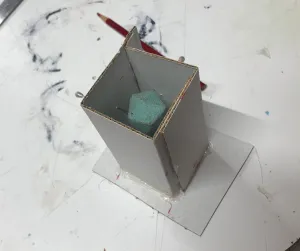
As with the large models, I started by printing out a scaled-down template, glued it to cover stock, and created a hollow form. For the neck I slid a spring over a dowel and inserted the unit into a hole drilled in the solid head.
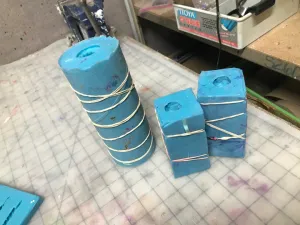

I hot-glued the head and neck assembly to a baseboard, then built a cardboard box around it. Into this box I poured liquid silicone. After curing, I cut the resulting cube nearly in half and removed the sculpture. The spot where the neck had been glued down became the pour-hole for casting plastic resin.
To make each casting, I held the half-severed mold together with rubber bands and filled it with the same clear resin used for the large models, tinted with a few drops of pigment.
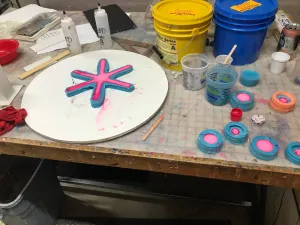
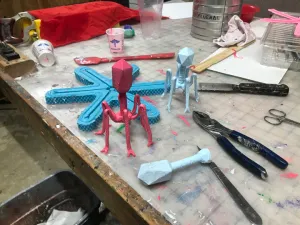
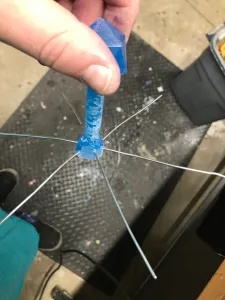
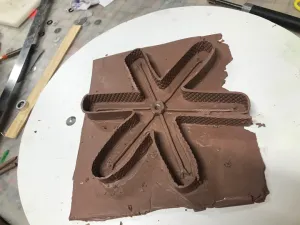
The miniature legs were made in one of two ways. One version used wire embedded in liquid resin, then shaped while still warm and flexible. Another version used a starfish-shaped mold, with a hex nut used for the shape of the base from which the legs extend.
Here are a couple of assembled phage figurines. Some are cast in opaque resin, so they won’t contain any lighting. Others use wire for the legs, painted to match the color of each phage body.
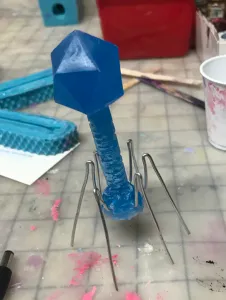

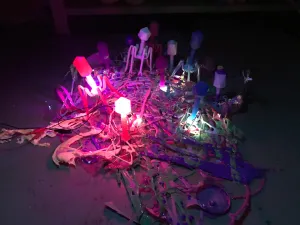
For some test footage of the figurines I threw together a make-shift set meant to resemble the molecular surface of a host bacterium being infected by the parasitic phages. To create my interpretation of the proteins that make up the outer membrane of a bacteria cell, I drizzled successive layers of surplus plastic resin onto wax paper instead of pouring it into dump molds.
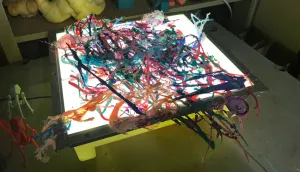
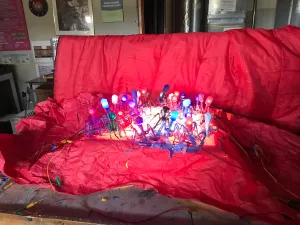
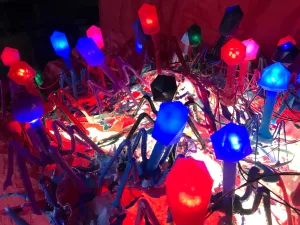
What I know about these structures comes from computer graphics based on current scientific understandings of what molecular surfaces might look like at atomic scale. Keeping with the idea of using inner lighting to represent the “life energy” inside cells and viruses, I placed the drizzle atop a small light table and surrounded it with red paper and fabric to create the final look.
Test Video
Here is some test footage of the Bacteriophage figurines in action. Be sure to check out the next section for some scientific information regarding bacteriophages.
BACTERIOPHAGES
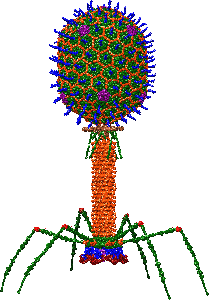
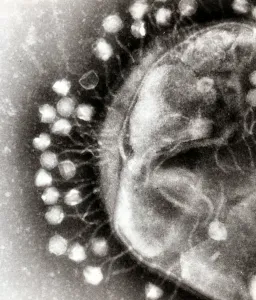
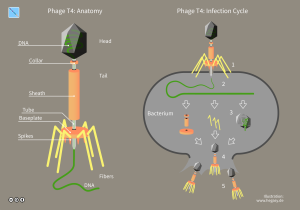
Also known informally as a phage, a bacteriophage is a virus that infects and replicates within bacteria and archaea. The term was derived from “bacteria” and the Greek word meaning “to devour.”
Bacteriophages are composed of proteins that encapsulate a DNA or RNA genome and may have structures that are either simple or elaborate. Phages replicate within the bacterium following the injection of their genome into its cytoplasm.
Bacteriophages are among the most common and diverse entities in the biosphere. They are ubiquitous viruses, found wherever bacteria exist, and are among the most abundant biological entities on the planet.
Phages have been used as an alternative to antibiotics in some areas and are seen as a possible therapy against multi-drug-resistant strains of many bacteria. The full article can be found at Wikipedia: Bacteriophage.